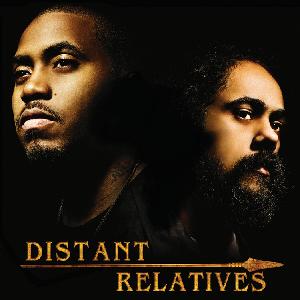
Distant Relatives – Nas and Damian Marley

Distant_Relatives_(Nas_&_Damian_Marley_album)

In 2010, a fusion album dropped that would change the way I viewed hip-hop fusion albums, that album was Distant Relatives by Nas and Damian Marley. It was the most innovative mix of rap and reggae that I have ever heard. It is such as perfect fusion of the two genres, that I have a hard time calling it a hip-hop album as it could just as easily be a reggae album with rap verses. For those of you who are not familiar with either artist, Nas is regarded as one of the best rap lyricists of all time, hailing from Queens, New York, where he began recording conscious rap music in 1994. Damian Marley is the son of reggae legend Bob Marley, and brings an uptempo rhythm to reggae music. Damian has won a few Grammy’s for his albums The Halfway Tree and Welcome to Jamrock. Both are artists that are at the top of their field, revolutionizing their genres.

When Distant Relatives came out, it was at a time when people, including Nas, had claimed that hip-hop was dead. That is why I found it so strange that he was able to contribute to an album that proved that hip-hop was not only alive, it was growing in new and exciting ways. From the opening track, As We Enter, it was clear that there would be a back and forth between the two MC’s over bass heavy beats. You could tell that they were speaking as a voice of their respective communities that were so distant in proximity to one another, yet so similar in nuanced ways. It was a party track that got the album off to a fast start, yet really didn’t have the light lyrics to match the uptempo beat.

The next song on the track on the album, Tribal War, had the albums first guest feature from an up and coming Somalian rapper named K’naan. I had actually first learned about K’naan back in 2007 when he opened for Stephen and Damian Marley on the Mind Control tour. The track introduced an African theme that would be present through much of the album. This song spoke about the need for humans to divide ourselves into tribes, and engage in conflict. This song also made the connection of the album title, because we are all distant relatives. K’naan from Somalia, Nas from NY, and Damian from Jamaica can all trace their ancestry to the continent of Africa, which is why the addition of the African beats into the album was a great concept. K’naan makes another appearance at the end of the album on the final track Africa Must Wake Up, which is an uplifting song about how the future is bright for Africa despite some dark days ahead. We hear K’naan spitting some raps in his native language which was pretty cool.

This leads me to one of my favorite track on the album, Patience. Patience uses a sample from the famous Malian duo Amadou and Mariam’s song Sabali. Sabali is the Bambara word for patience. I had heard this song when I first listened to the album, and even though I liked it, it was not an instant favorite. Then I heard Amadou and Mariam’s song when I served in Mali for the Peace Corps, and I was blown away. They used the sample, and did it a lot of justice. The beat was trance like, with Miriams gentle voice echoing on the chorus. This made me pay special attention to the lyrics of the verses, and I began to pick up subtleties that I had not picked up on before.

Another theme on this album is hope, and there were two tracks on Distant Relatives that evoked strong feelings of hope for me. Count Your Blessings is one of the most uplifting songs I can think of, reminding the listener that even when times are tough, you should always be thankful for the things that you do have. The other hopeful song was My Generation, featuring Joss Stone who is a powerful voice in the R&B world, and Lil Wayne, a rapper not known for his political or substantive raps. Both of them added great depth to the song. My Generation also features a chorus of children singing in the background, reminiscent of I Know I Can, on Nas’s God’s Son album. Both tracks put the listener in an uplifting mood, and you can’t help but sing along.

This leads me to my favorite track on the album, Nah Mean, which had the most traditional hip-hop beat on the whole album. What else can I say, other than it sounds great turned all the way up on your system when your driving. Again we see the great chemistry between Nas and Damian as they trade lines on the verses. We see a bit of the gangster persona that both artists have showcased on previous albums. At the same time we are also presented with issues of injustice, as they call out the president and prime minister for not caring about marginalized communities. For those of you who are not familiar with the term Nah Mean, it is basically slang for ‘do you know what I mean’.

Other rappers have tried to do fusion albums with other artists, but they never end up sounding natural. Jay-Z has done it a few times, with R. Kelly for the Best of Both Worlds, as well with Kanye West with their album Watch the Throne. Both of his albums seemed like they were manufactured by some studio executives to sell a ton of records, but really had no substance. Distant Relatives differs so much from Jay’s fusion albums, as every song is substantive. You get the feeling that Nas and Damian are attacking the system, while other rappers are deeply entrenched in the system. From gentrification, to war, to inequality, to hope, and to love, the listener connects with the themes and doesn’t merely feel like an observer, but a participant in the Distant Relatives experience.

Justice: A Roadblock to Peace

No justice, no peace. This is a phrase that is used often during protests and other political demonstrations, in which the protesters demand that justice be served or else they will continue to disrupt the status-quo. Based off of this mantra, it should lead us to assume that if there is justice, there will be peace. The term justice is used by many groups from all across the political spectrum, but justice is a very subjective term. What is justice to one group may be retribution to another group. Is justice a necessity for peace, or does the framework of justice get in the way of true conflict resolution?

Lets start with a narrative that has been etched into the psyche of of our collective culture in the United States, September 11th, 2001. On that day, more than thirteen years ago, the United States was attacked, and our elected officials agreed that the attacks were carried out by Al Qaida, an extremist Islamic group headquartered at the time in Afghanistan. The people who carried out the attack died along side their victims that day, but the United States wanted justice. We will never forget President George W. Bush standing at the rubble where the twin towers stood, promising the American public that justice would be served. In the weeks and months that followed, the United States set out on its quest for justice, invading Afghanistan and defining a new Global War on Terror (GWOT). The war was accepted as just, and in order for our country to heal there must be justice.

Thirteen years have passed, and our country is still in Afghanistan. The leader of Al Qaida, Osama bin Laden, is dead. Khalid Sheikh Mohammad, the alleged mastermind of the 9/11 attacks, is captured. The questions we now have to ask ourselves are, has justice been served? Are we better off as a country? If justice has been served, are we better off? In our quest for justice, we have shifted our paradigm of the conflict from seeking justice, to ensuring that a 9/11 style attack never happens again. The torch has been passed from President Bush to President Obama, as we preemptively seek justice from those who even think of doing us harm. As the GWOT continues, it is clear that we are still engaged in conflict, so there is not yet peace. This begs the question, that if justice was served, why isn’t there peace?

One reason that there might not be peace is because of our desire for justice. In the GWOT, thousands of people, on all sides of the conflict have lost their lives. Families have been torn apart, and people have been displaced. We have expanded our justice quest into Iraq, Syria, Yemen, Somalia, and Pakistan, just to name a few of the countries in which we are engaged in the GWOT. Support for the war has decreased since its inception both here in the United States and around the world. Our list of enemies has increased, and the prospect of peace appears increasingly harder to find. For those who advocate the prolonging of this war, justice must be continuously sought, but at what cost? When does the cost of justice outweigh the benefit? Will the justice sought by the architects of the GWOT ever be achieved?

Over the past few months, we have dealt with calls for justice in a renewed yet ongoing conflict, between our nations law enforcement officers and marginalized communities. We have seen time and time again, cases where the very people who we entrust to protect us, are causing what many believe to be unjust harm. Millions of people across the United States and the world have taken to the streets to demand justice be served to the police officers who they believe murdered unarmed black men. When Darren Wilson, an officer who killed unarmed teen Michael Brown in Ferguson, Missouri, and Daniel Pantaleo, an officer who killed the unarmed Eric Garner in New York City, were not indicted, it caused many to believe that the system is flawed. In order for justice to be met, the protesters believe that the police officers who killed the men must be indited, and face a trial where they will be judged by a jury of ordinary citizens.

Again, we must ask ourselves if justice is served to the police who kill unarmed black men, is peace achieved? Is peace ever achieved by justice, or does justice serve to prolong the conflict. If justice is served against Wilson and Pantaleo in the way that the protesters see fit, there will undoubtedly be those who believe that inditing our police is an injustice, and they were doing their jobs. We are a society of laws, and there will always be a need for justice, or the threat of justice as a deterrent. Once the cost of seeking justice is no longer cost effective, we must seek other means to resolving the underlying causes of the conflict. If we examine the root causes of the conflict, it will be more cost effective in the long run, as we can rely on the administration of justice less.

After 9/11, we needed to heal, and in a realpolitik world, we must let it be known that there are consequences to attacking the United States. Justice did not help to heal our collective consciousness, but rather served as a deterrent. Now that it has proven to be less of a deterrent than previously thought, its time that we have a real dialogue with those who want to do us harm. Why did they attack us? Was their attack on us their quest for justice? In the cases of Wilson and Pantaleo, did they seek to carry out justice in the way they were taught? Is our justice system at odds with a peaceful society? As with all things in life we must strive to find a balance between justice and peace, but justice should not come at the expense of peace.

nopeace